 Marketing Week · February 2026
 Down dog
A dedicated brand community may never be large enough to nourish a brand in its own right, but it can exert a positive influence on its route to penetration and growth

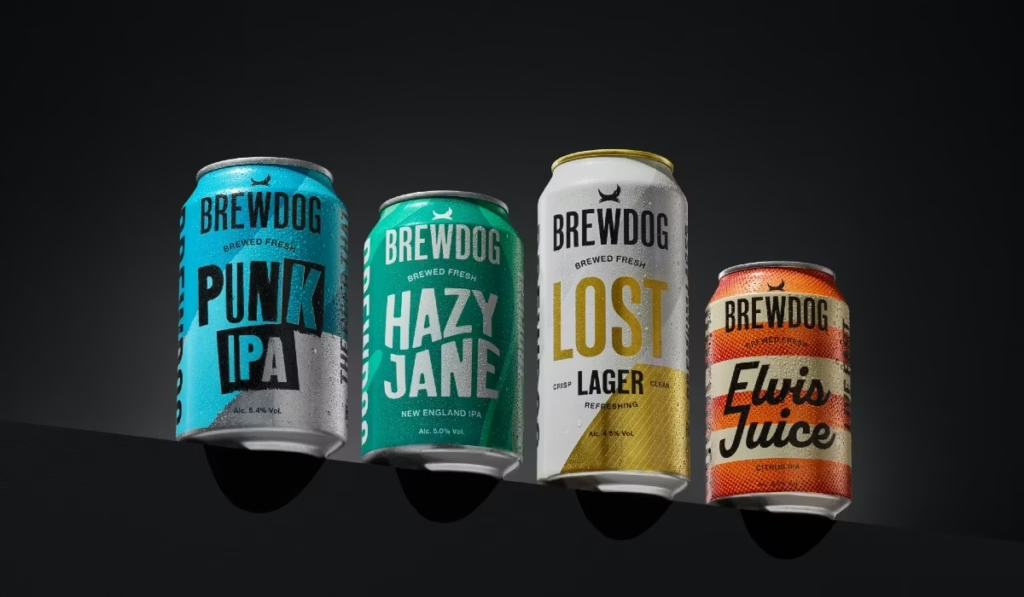
What can marketers learn from the downfall of BrewDog? The lossmaking craft-beer brewer, once valued at over £2bn, is looking at a sale that might yield no more than one quarter of that, busting its 200,000 community investors in the process.
Well, let’s start with the meta truth in any brand story that goes bad, which is that, for there to be a downfall, there must have been an ascent in the first place. And it is often there, in the dizzying, dazzling leaps on the way up, that the most valuable lessons can be extrapolated – the very ones that get forgotten in the media feeding frenzy when the brand is down on the floor.
For marketers looking at BrewDog’s route to success, rather than its subsequent failures, there are riches of tutelage to pore over: the obsessive focus on product; the courage to take on a huge but complacent category and be utterly different; the speed to market with innovations; the supple fusion of spontaneity and silicon valley-style test and learn.
The one I’m going to focus on now relates to those 200,000 small investors, and turns the spotlight on an important strand of academic marketing theory that, itself, burst onto the scene with a bang in the early days of the century and has been much neglected since.
The theory was proposed by US social scientists Albert Muniz and Thomas O’Guinn in a 2001 paper on what they called ‘brand communities’. Citing Harley-Davidson and Apple as examples, they showed that devotees can coalesce around the brand and experience a powerful sense of togetherness that transcends locality, sharing habits and attitudes and recognising in each other what the authors term a ‘consciousness of kind’.
When BrewDog initiated the first of its seven rounds of ‘Equity for Punks’ share offers in 2009, it provided some soft structure around which a genuine brand community – not just a disconnected audience of passive followers – could organically grow.
And it did. Yes, some invested because they saw the potential for gain and maybe the chance for this exciting business to someday float. But scour the online forums, even now, after all the disappointments, and you’ll see frequent references to a community back then that was brought together by nothing more than beer and attitude.
The shares brought privileged access to both. For a minimum £100 holding, punk investors earned lifetime discounts on the beers, and invitations to BrewDog’s Aberdeen-based AGMs – where the ‘M’ was deemed to stand for ‘mayhem’. In 2018, over 8,000 shareholders turned up – one of the biggest attendances for any AGM anywhere in the world.
In and out of fashion
For a while, Muniz and O’Guinn’s work was all the rage in marketing and ad planning departments, at a time when extreme brand loyalty – typically depicted on charts with a logo-tattooed bicep – was avidly pursued. The theory fell out of fashion with the ascent of the Ehrenberg-Bass evidence-based marketing approach, which poured cold water on loyalty and encouraged a focus on penetration instead.
A lesson for marketers right here is not to unthinkingly set two desirable things in opposition. One can give rise to the other. A dedicated brand community may never be large enough to nourish a brand in its own right, but it can exert a positive influence on its route to penetration and growth. Especially in the early days, impassioned advocates create a buzz that others can’t help but notice, and give retailers reasons to take a chance and stock.
BrewDog’s investor community was pivotal in its ascendance to fame. They bought the beers – and sometimes played a part in creating them. They bought the shares – endowing the brewer with a £75m war chest with which to build facilities, open bars and take the brand international. And they bought into the brand’s iconoclastic anticorporate ethos – helping it maintain the aura of microbrewing authenticity even as it became a supermarket staple.
Tragically for them, BrewDog turned out to be no Harley and certainly no Apple. Which brings us back to the question at the top. What can marketers learn from what went wrong?
On this side of the ledger, you’re looking less at learning than reinforcement of principles that any senior manager will already have imbibed.
What marketer wouldn’t have been horrified to hear in 2017 that leadership had struck a deal with a private-equity investor that gave priority to its acquired 22% stake in the event of a sale or IPO, summarily relegating the holdings of the punk investors to back-of-the-queue, ‘B-share’ status?
What marketer wouldn’t have gasped in disbelief at the loan shark-like interest rate guaranteed to this new investor – 18% per annum compounding – all but ensuring fiscal meltdown unless the brand achieved near-miraculous levels of growth?
And what marketer would not have understood intuitively the devastating impact on brand equity that would arise from the persistent allegations – whether founded or otherwise – of a culture of fear in the workplace?
In the end, ‘be fair and decent to everyone, but especially your loyalists and your own people’ may be a worthy mantra, but it hardly merits the status of revelation.
So, when the full, rise-and-fall BrewDog business case comes to be written, the marketing community’s gaze will swoop most hungrily on Part 1. Any normally competent marketer will already possess the acuity to avoid willingly becoming party to the kind of self-imposed errors that sent the brand tumbling down from its peak.
But it is a rare marketer indeed with the natural gifts to have played a meaningful part in scaling that peak in the first place.