 Marketing Week · October 2026
 Give it some time
New CMOs make these swingeing changes because they can

When Boots CMO Charlotte Lock briefed communications group WPP for a new advertising campaign, her instruction to the agency team was trenchant: “Make me feel uncomfortable.”
While I might have question marks over the specifics of that phrase – if she’d fallen in love with the work at first sight, she’d logically have been obliged to reject it – I am fully on board with the general intent. Marketers of mass, mainstream brands often tell me they worry that their agency might not strive for creative heights on their briefs, but settle for something correspondingly middle-of-the-road.
They are right to worry. Creative agencies, whether they admit it or not, practise a kind of triage of the briefs that come their way, directing the ones they see as ‘creative opportunities’ to the cream talent and the ones for mass, midmarket brands to safer pairs of hands.
If you’re tantamount to a national treasure brand, like Boots, with a 180-year presence on the high street, the work you get back might suffer from an excess of respect. If you want bigger and braver than that, you have to ask for it. Lock did.
To what extent the resulting campaign, which launched last month, troubled her discomfort gauge is hard to tell. It’s certainly big – women at various stages of life defy what’s going on for them biologically to come out laughing, dancing and flaunting, with the help of Boots beauty products and health services. They’re giving life some welly – reflected in the new slogan ‘Give it some Boots’ – all to a remake of Nancy Sinatra’s rhythmically hypnotic 1966 hit, ‘These Boots Are Made For Walkin’’.
The work is intended to challenge established notions of female wellbeing, but it would feel a whole lot braver showing a 73-year-old woman looking, as Lock puts it, “flipping gorgeous” if Dove hadn’t got there first 22 years ago. It doesn’t shock now, but comes across as more apt than unexpected, which I guess is not such a terrible place to be.
Nevertheless, if I were one of the other heads of disciplines around the boardroom table at Boots, I would be feeling a certain discomfort at the launch. Not at the work itself – you can’t really argue with an all-positive depiction of the sprawling Boots customer offer, and a four-syllable slogan where one of those syllables is the brand name.
What I would feel distinctly uneasy about is something more fundamental: this is the third new brand campaign, third brand slogan, third brand positioning in the space of five years. Is this really the way marketing is meant to be done?
No, it isn’t.
Great brands are consistent
Whenever I work with marketing teams in sights-raising workshop sessions, I always start by asking them what they consider the defining characteristics of great brands. Consistency is almost always top of the list, a kind of necessary and obvious requirement, to the extent that ‘inconsistent brand’ feels practically an oxymoron.
And when I solicit examples, it doesn’t take long for the usual ones to crop up: Nike, Red Bull, L’Oréal. The slogans that crystallise their distinctive brand positionings are also readily recalled, which isn’t so surprising when you consider how long they’ve been with us: ‘Just do it’, since 1988; ‘Gives you wings’, since 1987; ‘You’re worth it’, since 1971.
But here’s the issue. The reason these brands and their enduring slogans come quickly to mind is because they are exceptions. For all the ubiquity of marketing’s insistence on consistency as a baseline requirement, most brands succumb to periodic drift, redirection or cliff-face change, as marketing leaders come and go.
Here, Boots can serve as an example, since it is current – but it is by no means an unusual case in its peripatetic and uneasy shifting from one encapsulation of brand meaning to the next.
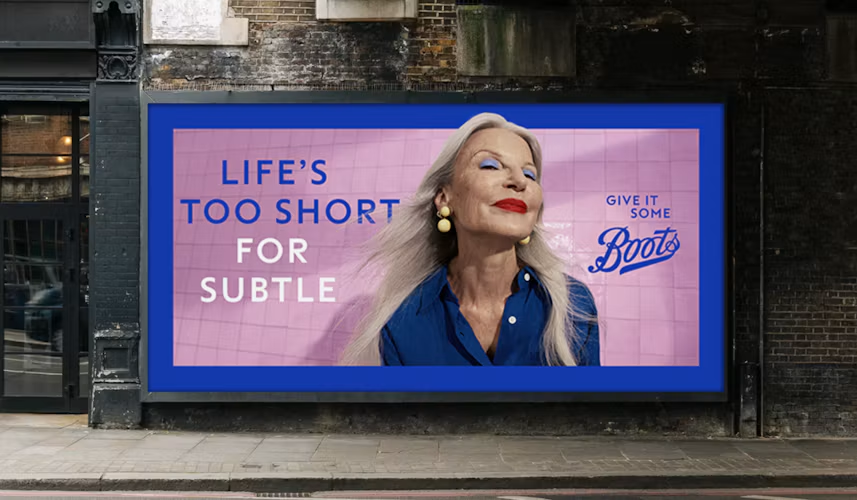
When Lock arrived as customer and marketing director in November 2025, she replaced Pete Markey, who in turn had replaced Helen Normoyle in 2021. Normoyle’s view was that Boots was a wellbeing brand, which was emphasised with the simple, spare slogan, ‘Feel good’. Markey launched his tenure in the CMO seat by averring that merely feeling good had lost relevance, and sought a life-partner positioning under the somewhat less snappy slogan, ‘With you. For life’.
Now we have ‘Give it some Boots’, and an outright confidence positioning, launched by Lock with that word ‘relevance’ again. If the consumer might find it hard to keep up – which we’ll come to later – a more insidious problem is the internal one: the brand cannot keep up with itself. The dissonance is clear the moment you visit a store.
Where I live there is a big Boots store and small one, and it is that smaller branch that I would think is representative of the reality in most high streets: homely, familiar, unexciting, cramped, addicts leaning outside – a million miles away from the high-octane dance routines of the ads. On the windows of the store is emblazoned ‘Feel good’ – the slogan from two chief marketing officers ago.
The bigger store, meanwhile, is more enticing, with its big, ground-floor beauty department, but even here the incongruous encroachment of the sandwich section brings you peremptorily back down to earth.
Of course, it’s not beyond the heads of those other disciplines around the boardroom table to help marry image with reality. Operations could make the estate changes to bring more excitement to smaller stores – or at least get the latest slogan displayed – and HR could play its part in internal brand engagement to help the human delivery of the new brand meaning, which is so important in a retail context.
But you could hardly blame those leaders for sitting on their hands as they contemplate the probability of yet another chief settling soon into that marketing hotseat, and determining yet another switch of brand emphasis.
The tussle between maintenance and change
The question we as marketers need to confront is why this happens – not so much why CMOs move on so quickly, which has long been a norm, but why they feel the urge to change things when they do. There are two kinds of answers: the proximate one and the higher-order one.
The proximate answer is that you can always find something in the data that will make the case for a sweeping new approach to brand meaning. True, an alternative interpretation of that same data might suggest a maintenance-and-refresh approach, but human nature decrees that change will tend to win this little tussle.
A brave new positioning, campaign and slogan is something immediately ownable for a new CMO seeking to make their mark. It gives heft to the CV. It gets you talked about in the industry, fêted in the press and adored by agencies, for whom ‘maintenance’ is a low-watt challenge.
The higher-order answer is that new CMOs make these swingeing changes because they can. Or at least they can unless they happen to be holding the reins in one of those exceptional brands like Nike, Red Bull or L’Oreal – where there is either something carried in the ether, or somebody very senior carrying a big stick, which warns, ‘You don’t meddle with this’.
Most brands are far more up for grabs, and CMOs have enormous power to lobby for change – more than perhaps our industry should encourage. And that applies especially to brands with no clear and unequivocal centre of gravity.
The curse of confusion
Which brings us back to Boots. Here is the place to go if you’re in the mood to browse lipsticks, could fancy a ‘no-duck and hoisin vegan wrap’, and happen to need a shingles jab. It’s an ungainly, all-over-the-place sort of offer, jerry-built on long-since superseded pharmacy foundations.
Lock will argue that she’s put her arms around all that by celebrating the emotional feelings the brand inspires – and there is sense in that. But emotional brand engagement is not the work of a moment and will not be achieved until there is greater cohesion between what the brand says and what it does. In which case, the mantra would be: give it some time.
If Lock stays in role for the long term, then you could see her rallying her boardroom peers to respond with imaginative substantive support for the positioning and instructing her agencies to keep the work fresh but disciplined and consistent.
But as a star marketer with not just Boots but John Lewis on her CV, you wouldn’t bet against her moving on again to an even more prestigious challenge. If so, she would want her successor to continue her work. But that is what her predecessor would have wanted from her, and she self-evidently wasn’t up for that.
If Boots continues to bring in big marketing names to the CMO role, and leaves them free each time to start from brand square one, then the brand meaning will fissure under the weight of its own contradictions, and people will struggle to identify its role in their lives.
The fate, in other words, that befell another venerable high street name that was national if not exactly a treasure: the once ubiquitous WH Smith, now confined to trading in transport hubs.
It is a reminder of which foot the boot is always on: that of the consumer. We might flatter ourselves that they might use it to give us a corrective kicking when we take our brands to conceptual places that don’t square with their perceptions.
The truth is more pernicious than that. One of these days those boots are gonna walk right past the doors of our confused brand edifice, even as their owners profess their affection for the brand, and tell us it was always their mum’s favourite, but no, they can’t seem to find a reason to stop by just now. And there is nothing but cold comfort in that.